
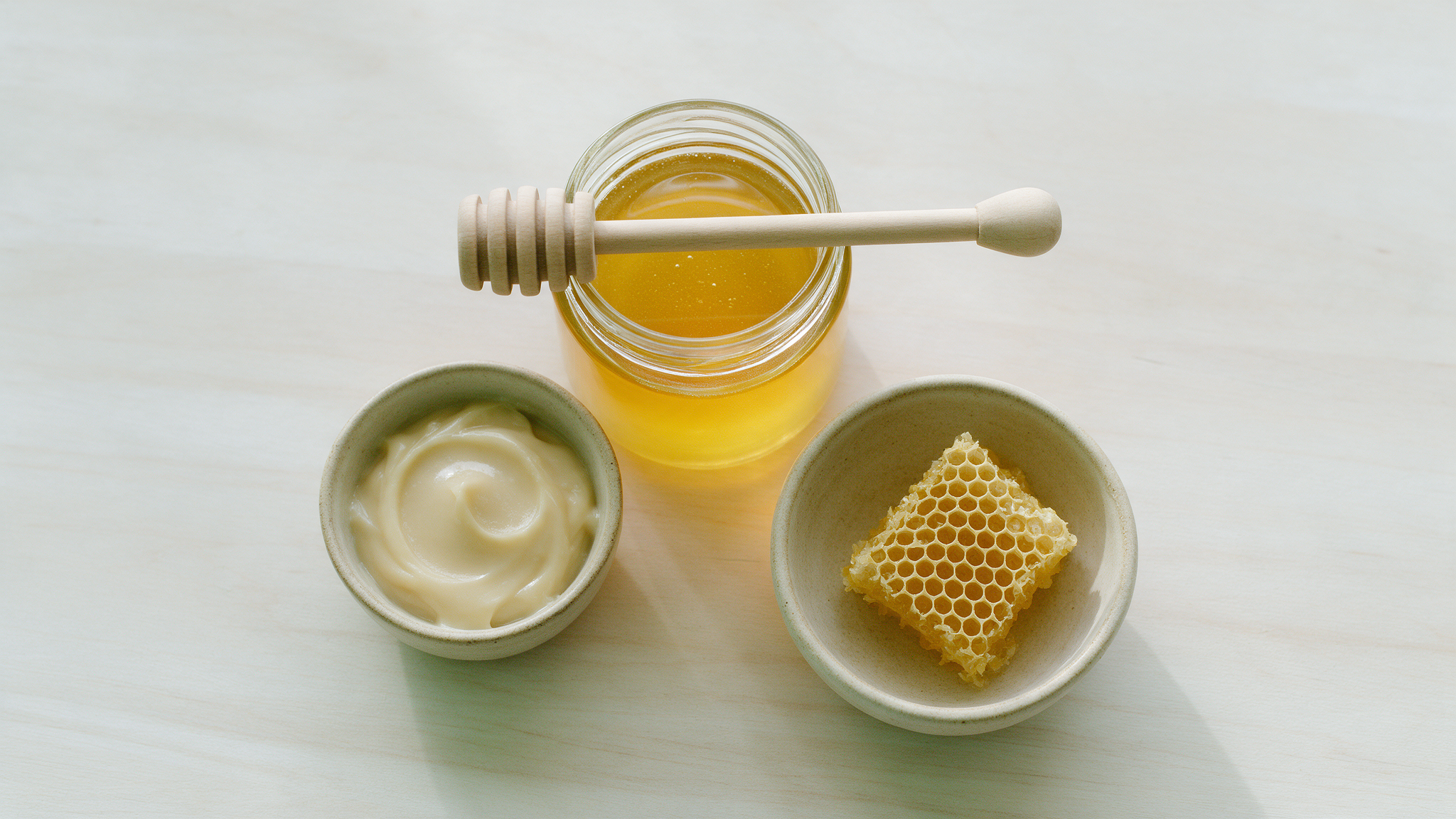
Honey is one of the most commonly counterfeited products on store shelves. It’s diluted with water, old honey is remelted, different varieties are blended together, and sometimes it’s even replaced with sugar syrup. That’s why the question “how to choose real honey” is on many people’s minds—but it’s important to understand that natural honey and organic honey are not the same thing. Let’s take a closer look at both.
7 things to look for when buying
- Consistency. Fresh honey has a uniform texture without sediment or separation. Crystallization is normal—it’s not a defect: the rate depends on the variety (sunflower honey thickens within a week, while linden honey can remain liquid for years). However, liquid honey in winter or spring is a cause for concern: it’s usually harvested from late spring through early fall.
- Viscosity. Fresh, mature honey flows from a spoon in a thin, continuous stream and forms a mound, with the last drop appearing to “spring back.” Immature honey flows quickly and runny.
- Aroma. High-quality honey smells of herbs and flowers. A lack of aroma or a sharp chemical odor is a bad sign (although a faint aroma in winter due to the cold is normal).
- Taste. Sweet, sometimes with a slight bitterness, it dissolves in the mouth without any noticeable sugar granules. A sour taste, a hint of mash, or a foamy aftertaste are signs of fermentation; a caramel aftertaste is a sign of overheating.
- Color. It should match the declared variety (buckwheat honey is dark, while acacia honey is light and almost transparent). If dark honey is being sold as linden honey, that’s a reason to ask the seller.
- Container weight. One liter of mature honey weighs 1.3–1.5 kg—an 800-ml jar should feel like it weighs about one kilogram when held in your hand.
- Documentation. You have the right to ask any seller for the apiary’s certification and laboratory test results, especially at a market or fair.
Simple home tests (not foolproof, but they help spot obvious counterfeits)
- A drop of honey on paper should not leave a wet, spreading stain—if it spreads, there is excess water in the mixture.
- A spoonful of honey dissolved in a glass of warm water: slight cloudiness, floating wax or pollen, and propolis sediment are normal; any other sediment is a cause for concern.
- A piece of bread dipped in honey: if it’s real honey, the bread stays firm; if it’s diluted with water, the bread gets soggy and falls apart.
- Add a few drops of iodine to a solution of honey and water: if it turns blue, it indicates the addition of flour or starch.
- Diluted honey with vinegar added: fizzing indicates the presence of chalk.
All these methods detect only isolated, fairly crude irregularities—none of them replaces an official analysis. The most reliable option is documentation and lab tests obtained before the purchase.
Why This Isn’t the Same as “Organic”
Here’s an important point that’s often overlooked: all the signs and tests listed above only verify whether the honey is genuine—whether it’s been diluted with water, substituted with sugar syrup, or overheated. This is a matter of the product’s authenticity.
“Organic” is a completely different, broader characteristic: it refers to exactly how the product was produced. For honey, this specifically means—not adulteration, but compliance with the rules of organic beekeeping as outlined in GOST 33980-2016: restrictions on the use of antibiotics and synthetic acaricides in treating bees; requirements for the apiary’s location away from pesticide-treated fields and industrial facilities; and the organic composition of the feed used to supplement the bees’ diet. Honey can be completely genuine (passing all home tests)—and yet not be organic if the apiary is not certified. Conversely, formal peculiarities—such as a liquid consistency in winter for a certified product—almost certainly indicate simply a different variety or storage conditions, rather than a counterfeit.
How to Verify for Sure
The only reliable way to ensure that honey is truly organic is to find the producer in the official registry of the Ministry of Agriculture or in our OrganicHub catalog, which is based on that registry. The catalog already lists 15 producers with honey and beekeeping products in their assortment, all with valid certification.
We’ve already discussed how “organic” differs from “eco” and “bio” and why organic products cost more—the same logic applies to honey: the label on the jar guarantees nothing; only verifiable certification does.
Sources
- How to determine the quality of honey at home — media.halvacard.ru
- GOST 33980-2016 (requirements for organic production, including beekeeping)
- Federal Law No. 280-FZ of August 3, 2018, “On Organic Products”
Leave a Reply